
Tree Canopies Are Quietly Killing Residential Developments

Updated: Nov 18, 2025
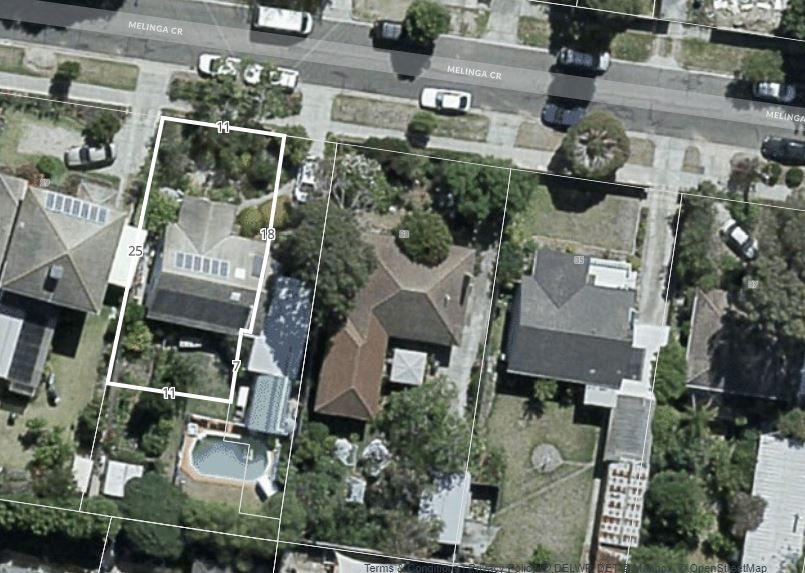
The new low-rise policy has landed and buried inside it is a table most people will skip over—but developers can’t afford to.
Table B2-7.1 now controls canopy requirements for small-scale residential developments like dual occupancies and townhouses.
Here’s the headline requirement:
Canopy Cover Requirement
Sites 1000 sqm or less: 10% of site area
Sites over 1000 sqm: 20% of site area
On paper this looks harmless. In practice, it’s a development killer.


A Real Example: The Typical 600sqm Dual Occ Site
Most dual occupancy sites sit around the 600sqm mark.
Under the new controls, that means:
10% canopy cover
= 60sqm of tree canopy
That’s not optional. And that 60sqm can come from one tree, or a combination of trees, as long as the total canopy area hits the target.
So far, fine.
Then we get to the tree canopy table, which tells us what species qualify and what canopy size they contribute.
Here’s the Catch!
Selecting one Type A tree + one Type B tree ticks the 60sqm requirement.
But the rules also say:
Those trees cannot overhang the building or the neighbour's land.
So you need to fully accommodate the mature canopy inside your site boundary—without letting it cross any line, wall, fence, carport, roof, or eave.
That means you’re not just providing 60sqm of canopy but In theory providing 61sqm of clear, undevelopable land in practice.
61sqm Lost = A Granny Flat Lost
Those 61 square metres could have been:
a small granny flat- housing for one or two real people.
a third unit in a dual occ project
or a larger dwelling
Instead, that land must now remain open to host a tree(s) that may or may not survive, thrive, or even be desired by the future owner. The canopy tree could be planted in the front setback, if possible, without hanging over the dwelling.
The irony? These are low-rise developments—the exact type intended to gently increase housing supply without overwhelming neighbourhoods.
We Love Trees, But…
Trees are essential. No one disputes that. We love green walls, smart trees and vegetation as a whole. Landscaping makes or breaks a residential project.
We like smart trees like the Liquid tree or trees that mine rare earths (saves digging up the landscape!)
*Liquid 3 (also known as Liquid Trees) is a clean energy photobioreactor project designed to replace the function of trees in heavily polluted urban areas where planting and growing real vegetation is not viable.
But we can’t forget:
People need a roof over their heads more than a theoretical canopy target on a spreadsheet.
When a tree canopy requirement wipes a dwelling off a site, it doesn’t just change landscaping—it removes a home or makes it smaller.
In a housing crisis, that trade-off needs serious reconsideration.
Add to this the mandatory Garden Area requirement! From experience we lost one whole unit on a 1056sqm lot because of the 35% (369 sqm) space allocated for Garden Area on the project.
In that project the Tree canopy was 20% or 211sqm of canopy chosen from a mix of tree types. Sure, the trees could be planted in the Garden Area as long as they did not hang over any roof or did not overhang each other!
Garden Area- that is permeable surfaces with a minimum dimension of 1 metre in width is as per this Garen Area table.

Are you thinking of doing a small residential development? You need to consider and address the following Clauses for Low Rise developments like a dual occupancy or townhouse project.


Comments